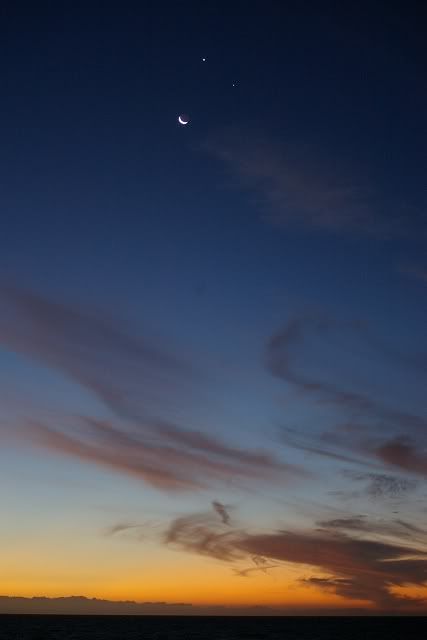
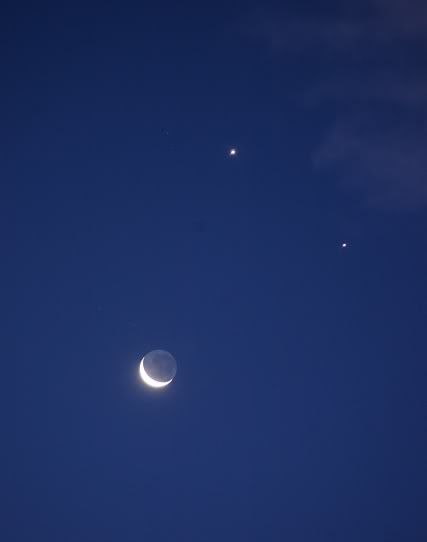
A close up of the three...
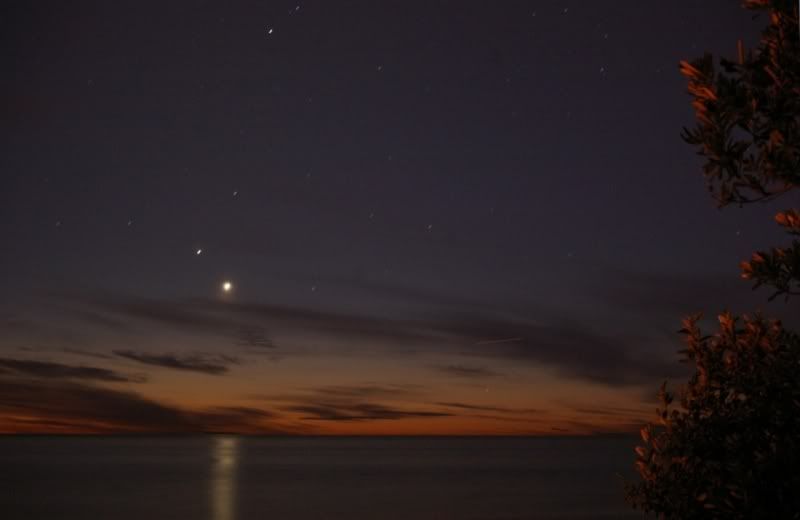
 We've heard of Moon beams. These last few evenings Venus has been sending her beam across the Gulf waters to viewers on the western shores of Adelaide (and anywhere else where there is a body of water to the west). She is joined by Mercury just to the upper left and Mars, the brighter of the two near the top edge of the picture. Venus and Mercury are gaining height each night and will join Mars next week. Larger image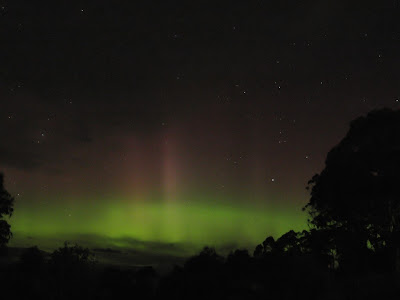


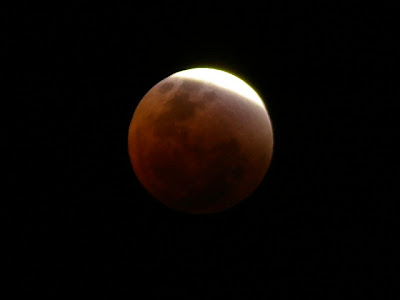

Just entering toality. The red colour is the light from a ring of sunsets around the circumference of the Earth falling on the face of the Moon
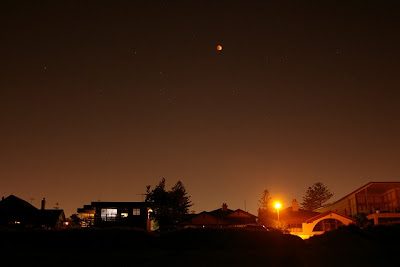
The totally eclipsed Moon bears ove the residential area at Henley Beach

Tatally eclipsed Moon over the Henley Pub

The end of the partial phase 21:52 CST

This sequence shows the appearance of Venus on July 10, 20 and August 6. As it moves between the Earth and Sun waning to a slender crescent increasing size as it gets nearer. On the evening of the last frame I could just make out the crescent in 10x50 binoculars. (Click on image to enlarge). ETX90-EC & Vivitar compact digital.
_____________________________________________________

Later in the Evening, at low elevation just above the horizon before setting, the light of Venus is spread out into a rainbow of rippling colours. Its light is dispersed by thicker layers of our atmosphere that acts rather like a turbulent prism. Maximum digital zoom. ETX90-EC & Vivitar compact digital.
________________________________________

Birth of Venus (Aphrodite) is depicted here emerging from the ocean "foam" in this 1879 rendition by William Bougereau (click to enlarge).
________________________________________

The changing phases of Venus are due to its perspective as seen from Earth as it orbits the Sun. It completes a cycle of phases in about 584 days (19 months). Venus reaches inferior conjunction on August 18 (closest to Earth) when it crosses to the morning sky and the sequence of phases will reverse. On rare occasions Venus will pass in front of the Sun as a Venus transit. http://members.ozemail.com.au/~mlewicki/venustranasit04.html
At superior conjunction it is on the far side of the Sun, appearing very much smaller with the full disk illuminated.
______________________________________
 This is my setup. The Vivitar 3930 camera mounted on a bracket to the Meade ETX90-EC telescope (9cm/3.5"). Planetary photography like you see here is made easier with digital cameras and electronics. You just keep adjusting the exposure settings until you get good shots. The telescope has remote control to reduce shaking from handling and the camera has delay exposure to allow vibrations to subside before exposure. This kind of planetary photography with a small telescope and compact camera would have been almost impossible with film and manual telescope controls.